Author name: mfsdraft.com

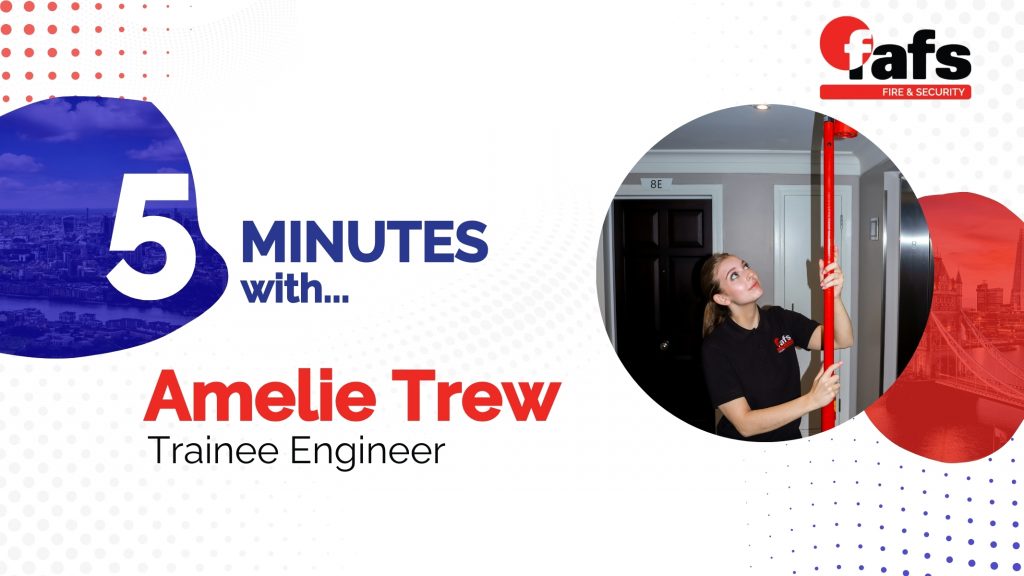
5 Minutes with Amelie Trew

5 Minutes with Amelie Trew, Trainee Engineer at FAFS Fire and Security   We sat down with Amelie Trew, a bright and ambitious Trainee Engineer at FAFS, to get a glimpse into her journey, her passions and what drives her in the world of fire and security engineering.     Name and Job Title: Amelie Trew – Trainee Engineer   Why did you decide to join FAFS? The fire and security industry has always been close to my heart, with my dad and brother both working in it. Seeing their passion sparked my interest, and after researching various companies, FAFS stood out as the perfect fit. My dad, Marc, works here, so I already felt connected to the team. Joining as a Trainee Engineer has been an amazing opportunity to grow and excel in a career I’m passionate about.   What does a day in your role look like? As a Trainee Engineer, my days are a mix of learning and hands-on experience. I conduct weekly system tests and assist experienced engineers on larger projects. Every day brings a new challenge and I’m gaining valuable exposure to different systems. There’s so much more to learn and I’m excited to keep building my skills.   What prepared you for this role? I had the chance to shadow my dad and brother on private jobs, which gave me a small but solid understanding of the field. When I joined FAFS, I had a warm welcome and a detailed conversation with Tom about what my first year would look like. That insight really helped me feel prepared and confident.   What’s been the highlight of your career so far? I’ve only been at FAFS for about six months but I’ve loved diving into the more complex problems on both the fire and security sides. It’s incredibly rewarding to learn how to fix challenging issues—it makes every day exciting.   What’s the best thing about working at FAFS? The team here is amazing. Everyone, from the service team to the engineers, has been so welcoming and supportive. Working alongside highly experienced professionals who are always willing to share their knowledge has been invaluable for my growth.   What’s your proudest achievement? In September, I passed the FIA Level 3 Fundamentals course—it was a proud moment for me! Outside of work, my last performance in a musical show was another highlight that I’ll always treasure.   Fun Facts about Amelie: She has a miniature long-haired dachshund named Alfie and two cats, Lily and Bella. Amelie dreams of traveling around Europe and performing in one of her favourite musicals someday. Her favourite place in the world? “Anywhere surrounded by friends and family!”     At FAFS, our team members like Amelie are at the heart of what we do. Their dedication and expertise ensure that we continue providing exceptional fire and security services across London and the South of England. Looking to join our team? View open vacancies 

5 Minutes with Amelie Trew Read More »

5 Minutes with John Horwood

5 Minutes with John Horwood: Key Account Manager & Head of Customer Services at FAFS Fire and Security   At FAFS Fire and Security we pride ourselves on having a dedicated and experienced team at the forefront of our success. Today, we spend five minutes with John Horwood, our Key Account Manager and Head of Customer Services, to gain insight into his role, his career journey and what makes FAFS a leader in fire and security services across the UK.     Name and Job Title: John Horwood – Key Account Manager & Head of Customer Services   What are your main responsibilities at FAFS? I joined FAFS in 1990 to establish and grow the service and maintenance department for the company, which had been formed two years prior. I served as Service Director and part-owner from 1990 to 2017. Since then, my role has shifted to managing key accounts and overseeing customer services. It’s been a long and rewarding journey, ensuring we provide excellent fire protection and security solutions to our clients.   What is your primary objective within this role? My main focus is managing our major key accounts while delivering exceptional customer service. Ensuring that our clients are always satisfied and their fire protection and security needs are met is at the core of what I do.   What did you do before joining FAFS? Before FAFS, I worked at FaceMacanda for 4 years, initially as a trainee fire alarm maintenance engineer, progressing to service and commission engineer, Service Supervisor and Service Manager. FaceMacanda, a company specialising in fire alarms and synchronised clock equipment systems. This background gave me the foundation I needed to thrive in the fire and security industry. From leaving school, and before I started my career at FaceMacanda, I joined Molins Ltd as an apprentice, working my way up from mechanical and electrical engineering to electrical/mechanical design draughtsman.   How has your experience prepared you for your role? With nearly five decades of experience in mechanical and electrical engineering, I’ve built a strong foundation for my career. My time at FaceMacanda, and later at FAFS, helped me hone my expertise in fire alarm systems. I’ve had the opportunity to build and grow a service and maintenance division from scratch, managing a substantial customer portfolio of around £1.5M by the time FAFS was acquired in 2017.   What do you enjoy most about working at FAFS? The camaraderie between the engineers, management and our customers is truly special. Many of our engineers have been with us for over 20 years, and some of our customers have stayed with us for over 30 years. The long-standing relationships we’ve built make FAFS a unique place to work.   What has been the highlight of your career at FAFS? I’ve been fortunate to play a key role in the success of FAFS, particularly in developing the maintenance division into a reputable and well-respected company within the fire protection industry. It’s been incredibly rewarding to see the business grow and succeed over the years.   Are you currently involved in any special projects? At the moment, I’m focused on continuing to promote FAFS and its unique attributes. I’m also dedicated to mentoring and supporting our staff to ensure that we maintain our high standards in the industry.   What makes you proud of your team and the company? Our team is exceptional. The engineering excellence, customer service and the continuous progress we make as a business are what I’m most proud of. We strive for success every day, and it shows in the relationships we’ve built and the services we provide.     Fun Facts about John:   Do you have any pets? I have a 28-year-old tortoise! What’s your favourite place in the world and why? Home – it’s where my family and friends are, and nothing beats that. What’s on your bucket list? To remain healthy, enjoy life with family and friends and to continue meeting new people.   At FAFS, our team members like John are at the heart of what we do. Their dedication and expertise ensure that we continue providing exceptional fire and security services across London and the South of England. Looking to join our team? View open vacancies 

5 Minutes with John Horwood Read More »

Evacuation Alert System

In the wake of the Grenfell Tower tragedy, the importance of efficient evacuation procedures in high-rise buildings has come sharply into focus. Introduced as a recommendation from the Grenfell Tower Enquiry Phase 1 report, Evacuation Alert Control & Indicating Equipment (EACIE) is a crucial system designed solely for use by the fire and rescue services during critical fire-fighting and rescue operations. Today’s blog delves into the intricacies of Evacuation Alert Systems (EAS), their operational independence from fire detection systems and their role in facilitating safe, efficient phased evacuations. Understanding these systems is vital for ensuring the safety of residents in emergencies and complying with evolving safety standards. Evacuation Alert Systems Introduced following recommendations in the Grenfell Tower Enquiry Phase 1 report, EACIE (Evacuation Alert Control & Indicating Equipment) is intended for the sole use of the fire and rescue service during firefighting and rescue operations. Evacuation alert systems are designed to help enable the phased evacuation of an area, floor or building in the safest possible way. EACIE is now strongly recommended in England for all tall buildings containing flats with a storey located at a height of 18 metres or more – and is mandatory in Scotland. The EACIE must operate completely independently of fire detection systems and be designed to support any evacuation strategy chosen by the fire and rescue service. What is an Evacuation Alert System (EAS)? An Evacuation Alert System (EAS) is a system, designed to be able to withstand fire for extended periods of time, for use exclusively by the Fire and Rescue Service (FRS).  It will only be used in the event that a fire in a building designed for stay put, is developing to the point where residents in the building are becoming potentially at risk from fire, and who need to evacuate. The person who makes the decision that evacuation is needed, is the incident commander. Normally, if the commander considers that there is a need to evacuate occupants of flats, this is done manually.  In rare situations, like Grenfell, it may be necessary to initiate a more extensive evacuation, where FRS resources are already stretched. What is the difference between a Fire Alarm System and an Evacuation Alert System? An Evacuation Alert System is not a Fire Alarm System. Fire alarm systems will normally detect smoke and heat and then trigger an alarm signal automatically to alert the occupants to evacuate the building. Evacuation alert systems are for use by the fire and rescue service only when the need arises to evacuate all or part of a building normally in stages, saving time in alerting occupants individually. The alarm system on an emergency evacuation alert system can be controlled by individual floors. This lets Fire & Rescue Services prioritise the zones closest to the fire and isolate the alarm alert so they can evacuate one floor at a time. The Evacuation Alert system does not incorporate any form of automatic detection. They provide an extra degree of assurance should evacuation be necessary and ensure the signal to leave can be effectively communicated to all within the building. What is the BS 8629:2019 Guidance for Evacuation Systems? BS 8629 is a “Code of practice for the design, installation, commissioning and maintenance of evacuation alert systems for use by fire and rescue services in buildings containing flats”. Evacuation Alert Systems (EAS) are a Requirement (ADB) for all new buildings (flats) and substantially altered buildings over 18 meters from December 2022.   There is no legal requirement to retrospectively fit evacuation alert systems to existing blocks of flats although it can be done. Evacuation alert systems are only to be used by the fire and rescue service and are only used if the fire and rescue service decide that “stay put” has failed. EAS are a recommendation of the phase 1 enquiry following Grenfell. Why? Stay put is usually safe but when it fails the fire service need a means of amending the evacuation procedure. Appearance of evacuation alert systems should be consistent to allow for ease of operating for fire service personnel. It is essential to consult with fire and rescue services at the design and installation stage of evacuation alert systems Equipment should be; 1 Indoors near the main fire service entry point or behind the concierge desk and clearly labelled 2 Lit, so controls and indicators are clearly visible to the fire service with an emergency light within 2 meters 3 Top controls should be 2.2 mtr above the floor 4 If more control units are needed then units should be mounted next to each other 5 72 hour standby power or 24 hours if a back up generator is present 6 Switch layout within the unit to be as “easy” to use as possible i.e. top switch relates to top floor of building Premises management should ensure the fire service and maintenance contractor have the correct keys. Units should never be accessible to the public or open to vandalism to allow persons to activate controls. Advisable (but not a requirement) to link systems to an ARC to allow for faults on system to be recognised early. Can consist of sounders, visual indicators, vibrating pads for under pillows etc. Wiring loops must not go into individual flats. Usually one sounder or indicator per flat will be sufficient however more may be needed in certain circumstances/layouts etc. Maintenance is 6 monthly although toggle switches are 12 monthly and incorporated into one of the 6 monthly maintenance tasks. There is NO full building alert function. Buildings are set up into zones so fire service can alert/evacuate certain parts as and when the need arises.   A single named member of the premises management team needs to be appointed to supervise all matters relating to the evacuation alert system. BAFE SP207 ​​​​​​​We are certified in accordance with the BAFE SP207 Scheme: For the Design, Installation, Commissioning & Maintenance of Evacuation Alert Systems. Following a thorough development process in conjunction with the fire safety

Evacuation Alert System Read More »

Emergency Lighting

Emergency lighting is an often overlooked component of a building’s safety infrastructure. In compliance with The Regulatory Reform (Fire Safety) Order 2005, a well-designed, installed and maintained emergency lighting system is essential for guiding occupants safely to exits in the event of a power failure or fire. Today we’ll explore the various facets of emergency lighting—from its importance in enhancing safety protocols to the innovative technology that ensures efficiency and aesthetic integration within any building. Understanding the specifications and maintenance requirements of these systems is key to safeguarding occupants and ensuring a swift, secure evacuation process. Emergency Lighting A well designed, installed and maintained emergency lighting system is an essential element of a building’s fire safety strategy. It is part of the fire safety provision of a building and a requirement of The Regulatory Reform (Fire Safety) Order 2005. In the event of a fire or any event affecting the power supply to your building and endangering your occupants the installed emergency lighting luminaires will activate and guide your people to the appropriate escape route and emergency exits, enabling a safe and efficient evacuation. We supply the latest technology with stylish and discreet fittings available to integrate seamlessly into the aesthetics of your site. In order to ensure the safe exit from a site the emergency lighting system luminaires must maintain a standard duration of lumination. Regular maintenance visits from a qualified FAFS Fire & Security Engineer ensures that the period of lumination is in accordance with British and European standards. Design, Installation, Maintenance FAFS Fire & Security provides a comprehensive emergency lighting service from consultation and design to installation and maintenance. We have the expertise to design and fit emergency lighting systems in new developments. Additionally, we can install them in existing buildings where existing wiring & power supplies may provide potential stumbling blocks. All installations are carried out in accordance with BS 5266-1: 2011 and meet your needs in terms classification and duration. We can ensure your system meets legislative requirements and your property maintains its aesthetic appearance. We have access to a huge range of different emergency light fittings to suit all modes of operation. Emergency Lighting Testing FAFS Fire & Security provide a maintenance and testing service to meet your requirements. Testing is in line with BS 5266-8 2004 and should include an annual three-hour drain test and a monthly functional test. Typically we try to help reduce our clients annual fire servicing costs by carrying out emergency lighting testing at the same time as fire alarm or AOV maintenance. Our quarterly or biannual service visits will incorporate an annual three-hour test and one of our functionality tests would be carried out on the remaining visits. If site staff are not able to carry out a monthly functionality test then FAFS Fire & Security can be employed to fulfil this requirement too. All maintenance and testing is logged and recorded and certificates of inspections are issued with details of any defects.   LED Emergency Lighting The manufacture of LED lighting technology is advancing at a rapid rate. This allows us to offer an alternative means of illumination to that of traditional fluorescent and old lamped fittings. LED emergency lighting systems provide a distinct advantage over traditional systems as the LEDs are far more efficient. Firstly they will provide you with savings on electricity. Our customers are recognising just how significant the annual electricity savings are having moved to LED fittings. In addition, the life expectancy of LED Lighting is greater which provides an additional cost saving. Typically LED fittings provide fifty thousand hours whereas traditional 28Watt 2D fittings require lamp changes at five to six thousand hours.   The Final Word We can’t understate the role of emergency lighting in building safety. With the advancements in LED technology and the stringent requirements set out by standards such as BS 5266-1: 2011, building owners and managers have the tools and guidance needed to implement effective and reliable emergency lighting systems. Regular maintenance and testing are essential to ensure these systems perform optimally when needed most. By choosing the right service provider, such as FAFS Fire & Security, and staying informed about the latest in emergency lighting solutions, stakeholders can make informed decisions that prioritise safety while managing costs.

Emergency Lighting Read More »

Gas Fire Suppression Systems

Primarily deployed in environments such as server rooms, computer suites, and communication rooms, Gas Fire Suppression Systems offer a high level of protection by efficiently removing oxygen from the environment to quench fires. Let’s explore in more detail the diverse types of gas suppression systems—including Novec 1230, INERT IG-55, CO², and Water Mist—and the critical importance of routine maintenance and Room Integrity Testing to ensure their effective operation.   Gas Fire Suppression Systems Fire suppression systems extinguish electrical fires by releasing a concentration of gas within a particular room, removing the oxygen and extinguishing the fire. Most commonly found in server rooms, computer suites and communication rooms a Gas Suppression system protects the integral functions of your business. We install, maintain and service all types of fire suppression systems: Novec 1230: A colourless gas, virtually odourless and non-conductive. It extinguishes fire mainly through physical means. INERT IG-55: A blend of Argon and Nitrogen which is found naturally in the atmosphere. It does not contribute to global warming and does not harm the ozone layer. It is highly recommended for the protection of electrical and electronic materials. CO²: Characterised by its rapid and efficient penetration in the area to be protected, it does not generate residue or decompose products. Water Mist: Some systems use water mist as part of the new generation of clean extinguishing agents. Room Integrity Testing Areas protected by fire suppression systems should, upon commissioning and regularly throughout the system life cycle, be tested for air tightness as air-leakage will result in the concentration of the fire suppressant agent falling too quickly and therefore not enabling the efficient extinguishing of the fire. These annual checks are known as Room Integrity Tests or RIT. How does a Room Integrity Test work? A Room Integrity Test works by creating pressure within the room or enclosure where the Fire Suppression System has been installed. The Test then measures the integrity of the room to ensure the gas does not dissipate too quickly before being able to extinguish the fire. It will also check to ensure the room is not sealed to tightly, as this may cause internal structural damage. What is the minimum retention time? Room Integrity Testing ensures the extinguishing agent will achieve the correct concentration and maintains it for a ‘minimum retention time’ value. The minimum retention time required under BS EN 15004-1 for all gaseous agents is 10 minutes, apart from CO² which has a minimum required retention time of 20 minutes. The ‘retention time’ is the period that the gaseous agent should exist at an acceptable design concentration (Cmin), whilst remaining above the minimum protected height to prevent the re-ignition of a fire once it has been extinguished. The ‘minimum protected height’ is a determined height from the base floor level to the top of any identified critical asset or risk, or as designated by the ‘responsible person’. The ‘responsible person’ should always be consulted with, and agree the minimum protected height, regardless. What type of system requires a Room Integrity Test? Common Systems that require a Room Integrity Test are FM200, NOVEC 1230, Co2, Inergen, IG55 and IG541. Due to the overall characteristics of FM-200 the sealing requirements for effective retention are much more stringent than those for any of the Inert agents. In general an enclosure protected with FM-200 needs to be sealed to reduce the leakage by at least half that allowed for the Inert Agents, this can and does have an impact on the structural sealing costs. If an enclosure has satisfied an Integrity Test utilising Halon as the medium it will definitely satisfy the requirements for any of the inert agents resulting in no additional structural costs. Unless the result with Halon is in excess of 12.5 minutes it will not satisfy the requirements for containing FM-200 resulting in the need for structural improvements inevitably leading to an increase in building costs. How often do I need a Room Integrity Test? Any gas fire suppression system that protects an enclosure should have a room integrity test when it is commissioned. It is a requirement of British Standards (ISO14520 / BS EN15004) and NFPA 2001 Code that a room integrity test is conducted on initial installation and thereafter at least annually. It should also be performed if any modifications to the room take place. What if the Room Fails? If a room fails an Integrity Test, we will give you a full report detailing the areas that failed and provide a bespoke room sealing service. Our trained engineers will attend and locate the leakage, this may be done with the use of smoke. Once the leakage is identified this will be sealed using specialist sealing products.   The Final Word Ultimately, the effectiveness of Gas Fire Suppression Systems hinges not only on the choice of agent but also on the integrity of the room or enclosure they protect. Regular Room Integrity Tests are critical to ensure that these systems perform as expected during an emergency, maintaining the necessary gas concentration to prevent re-ignition of the fire. By understanding the requirements for these tests and ensuring they are conducted annually—or more frequently if modifications occur—facility managers can significantly enhance the safety of their critical assets. Engaging with knowledgeable professionals who can provide expert installation, maintenance and repair services, such as those offered by our highly skilled and thoroughly trained engineers, is essential in upholding the standards of fire safety and ensuring the longevity and reliability of these sophisticated suppression systems.

Gas Fire Suppression Systems Read More »

Fire Alarm Cause and Effect Testing

Ensuring the safety of a building’s occupants against fire hazards is a fundamental responsibility for building managers and safety engineers. A critical component of a building’s fire safety strategy is its fire alarm system, which requires meticulous testing to guarantee its effectiveness in a real emergency. This blog explores the vital process of Cause & Effect Testing, as mandated by multiple safety regulations like The Regulatory Reform (Fire Safety) Order (RRO), Approved Document B, BS 9999, and BS 5839 part 1. By understanding the required compliance and processes involved, building managers can ensure their fire prevention systems are up to standard and can operate effectively when needed most. Fire Alarm Cause & Effect Testing In accordance with The Regulatory Reform (Fire Safety) Order (RRO), Approved Document B, BS 9999 and BS 5839 part 1, all modern complex buildings fire detection and fire suppression systems should be designed in association with a fire strategy and fire prevention risk assessment. The Fire Risk Assessment will determine and record the building hazards and risks and the fire strategy will determine the interactions and interconnections of the various building fire alarm systems with other critical building services to mitigate the risk, such as air handling systems, fire dampers, lift systems, security control systems, fire doors, remote monitoring and with the sounders or voice alarm speakers, and beacons and visual alarm devices that also form part of the fire alarm system. What is the purpose of Cause and Effect Testing? The purpose of cause and effect analysis is to document the current Cause and Effect of the fire alarm system within the premises, so that it is understood how the alarm system operates. The fire alarm systems triggers or inputs – call points, smoke/heat detectors, aspirating detectors, sprinkler flow/pressure switches – are the Cause, and the outputs or Effects are the shutting down of air supplies, opening of vents, closure of dampers, shutting down of fuel supplies, unlocking of access controlled doors, closing of held open fire doors, signalling to fire authorities, phased evacuation operation of sounders and visual indicators or voice alarm speakers. How often should Cause and Effect Testing be undertaken? BS 5839-1 section 45 regarding Inspection and Testing states that annually the Cause and Effects should be tested and in particular sites with multiple cause and effects operations more detailed testing should be undertaken. In order to prove the correct fire strategy operation it is essential that the tests are undertaken and checked as an end to end test, not just a test to fire alarm interface units or relays that provide the signalling mechanism to the critical building systems. It is important that the fire alarm system service provider can prepare a cause and effect testing matrix that is used to prove end to end function tests from the cause of call points and smoke detectors so that the responsible person can witness the correct effects operation on the associated fire strategy building services systems. The site inspection focuses on the following items: Condition report of the current fire alarm detection systems, including all linked systems. Confirmation of the current cause and effect of the system. Confirm the current fire strategy to the building and if any changes need to be made. Make recommendation for system upgrades or amendments to comply with current standards. What are the benefits of Cause and Effect Testing? Full visibility of activation locations Full audit trial of false alarm history Continuity across the property with regards to equipment and procedures Reduced need for multiple residents, customers or clients evacuating at one time. Sounders not being activated throughout property and causing disruption to occupants. In some case systems having the ability to remote connect to systems for reporting purposes and interrogation   Cause & Effect Testing is not just a regulatory requirement but a crucial safety practice that ensures all components of a building’s fire alarm system are functioning cohesively to safeguard both property and lives. Regular and thorough testing forms the backbone of a reliable fire safety strategy, allowing for immediate rectification of any issues and enhancing the overall security of the building. By adhering to the guidelines and ensuring comprehensive testing, building managers can minimise risks, reduce the potential for disruptive false alarms and provide a safer environment for all occupants. Ensuring your building’s fire safety measures are robust and reliable is an ongoing commitment to safety that should never be overlooked. If you’d like to partner with experts who can guide you through the complex world of fire safety, why not contact us?

Fire Alarm Cause and Effect Testing Read More »

The Five Step Fire Door Check

We walk past dozens of fire doors every day without even noticing them. Carrying out a regular fire door check is important. We don’t give them a second thought – at least, not until we need them. But fire doors are a critical element in preventing the spread of fire and smoke, and it should be everybody’s responsibility in a shared building to make sure that they are fit for purpose. The 5 step fire door check is something that anyone can do: Look for labels or markings that show the door is third party certificated and has traceability back to the original manufacturer. Look that the door is marked correctly with the appropriate signage and that it closes tightly against the frame. Ensure that the door or frame has the fire and smoke seal, and that the door closes correctly with an even gap all around of about 3mm. Check the fire-rated hinges are fitted firmly in the door and that there are no missing screws. Make sure the door is not damaged or ever wedged or propped open. Watch the Five Step Fire Door Checklist video below.

The Five Step Fire Door Check Read More »

The Importance Of Fire Extinguisher Maintenance

Professional maintenance of fire extinguishers is a vital part of any business’ fire safety strategy.   Understanding that the integrity of these systems need to be maintained to protect the safety of not only your premises and assets but also your employees and residents. Fire extinguishers must be serviced every 12 months or after each use by a BAFE SP101 certified service provider. If an extinguisher is found to be leaking, it should be serviced immediately. We offer a total fire extinguishers supply, installation and maintenance solution at a competitive price. We can provide a quotation based on quantities without the need to attend site. In addition we supply and install new extinguishers should any fail the maintenance inspections. If you have extinguishers on site, do you know when where they last maintained? If not you will find the details recorded on a service label located on the extinguisher. Contact Us for a free no obligation quotation.  

The Importance Of Fire Extinguisher Maintenance Read More »

School Holiday Security Tips

When the school holidays are approaching and it should be a time for fun and relaxing… However, according to statistics, the highest percentage of burglaries occur during summer months, and school vandalism and break-ins are a serious problem.   Criminals know that your school will be empty during the 6 week holidays and with this in mind, we have prepared some top tips to keep your school safe over the summer. 1. Add or enhance your CCTV Systems High quality CCTV cameras provide high resolution video footage and live streaming of what happens in school, 24/7 monitor the areas, trigger alarms and alerts to inform you when theft, vandalism and arson attacks occur. 2. Add or enhance your Intruder Alarm As well as immediately alerting the police to any issues, an Intruder Alarm can also act as a great visual deterrent to intruders. Ensure that your alarm is regularly maintained and that you change the code every six months to gain maximum benefit from the system. Your Intruder Alarm can be monitored by an Alarm Receiving Centre 24/7, and we also offer CCTV Systems that can be remotely monitored, so that you can check your facility at any time. 3. Make Sure Doors and Windows are Closed Most burglars break into a building through open doors and windows. Make sure all doors and windows are well closed and locked if the building is not in use. Ensure emergency exit doors have the correct escape hardware and are working well. Check if gates are fitted with suitable locks. 4. Avoid Lone Workers Even in the holidays, there are times when staff will need to go into school. This person will be vulnerable to criminals in waiting, or to missing security procedures. ConnectMe, our Lone Worker Solution, ensures your people are protected. Or use a Keyholding Service which can secure your building with an open and lock service. 5. Post and Enforce a Holiday Access Policy If part of the building is being used over the summer vacations by clubs, staff or community groups, you should post a holiday access policy and enforce it. An Access Control System allows you to control who comes into your school, when, and what areas of the school they can gain entry to. Finally, you may want to consider scheduling in maintenance work during the summer holidays so that the school is occupied some of the time. To find out how we can support you, please Contact Us to arrange a free, no obligation quotation.

School Holiday Security Tips Read More »

Scroll to Top